


Proposed Cemeteries Bylaw 2026
)
Waitomo District Council is reviewing the rules that help us manage Council cemeteries across the district.
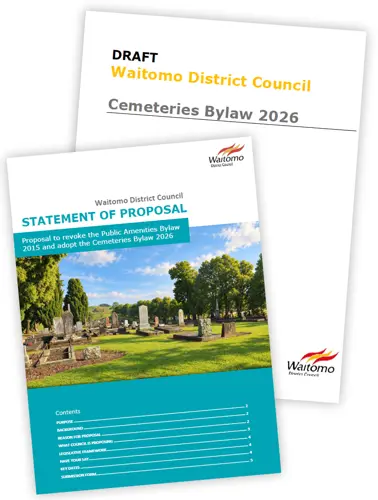
As part of this review, we’re proposing to revoke the Public Amenities Bylaw 2015 and introduce a new standalone Cemeteries Bylaw 2026.
Before any final decisions are made, we want to hear what you think.
What we're proposing
Council is proposing to revoke the Public Amenities Bylaw 2015 and introduce a new standalone Cemeteries Bylaw 2026.
The proposed bylaw largely carries over the existing cemetery rules, while updating the structure, wording and processes to make them clearer and easier to use.
The main changes include:
clarifying the requirements for purchasing an Exclusive Right of Burial and applying for an interment
updating provisions for publicly funded interments for people without means
removing the additional out-of-district fee
clarifying who can carry out memorial, construction and repair work in Council cemeteries
improving the layout, terminology and readability of the bylaw.
Overall, the proposal is about modernising and clarifying the existing cemetery rules rather than introducing major new requirements.

)
FAQs
Why is Council reviewing the cemetery rules?
Council reviewed the Public Amenities Bylaw 2015 in 2026.
As part of that review, Council found that most of the bylaw’s other provisions are now better covered by the Public Places Bylaw 2023 or the Library Management Policy. This leaves the rules relating to Council cemeteries.
Council is therefore proposing to revoke the Public Amenities Bylaw 2015 and replace its cemetery provisions with a standalone Cemeteries Bylaw 2026.
Why is there a separate Cemeteries Bylaw being proposed?
A standalone bylaw will make the rules for Council cemeteries clearer, easier to find and easier to understand.
It also provides a more appropriate framework for managing cemeteries, which are subject to specific legislation and operational requirements.
What is changing?
The proposed Cemeteries Bylaw largely carries forward the existing cemetery rules, while updating their structure, language and content.
The main changes include:
clarifying when an Exclusive Right of Burial must be purchased
making the burial application process clearer
updating provisions for publicly funded interments for people without means
removing the additional out-of-district fee
clarifying who can undertake construction and repair work within a cemetery
improving the layout, terminology and readability of the bylaw.
Which cemeteries will the bylaw apply to?
The proposed Cemeteries Bylaw will apply to all cemeteries vested in or controlled by Waitomo District Council.
The proposed bylaw clarifies that the installation or repair of memorials must be carried out by an approved person.
This helps ensure work is undertaken safely and to the required standard.
Are the rules around memorials and cemetery work changing?
The proposed bylaw clarifies that only a person approved or authorised by Council may install or repair a memorial or concrete base, or undertake other construction or repair work within a Council cemetery.
This is intended to help ensure work is carried out safely and to an appropriate standard.
What is an Exclusive Right of Burial?
An Exclusive Right of Burial gives the holder the right to have human remains interred in a specified burial plot.
It doesn’t mean the person owns the cemetery land.
Under the proposed bylaw, an Exclusive Right of Burial generally needs to be purchased before a burial can take place, except in the case of an eligible publicly funded interment for a person without means.
Is the burial application process changing?
The main change is greater clarity around the existing process, rather than introducing a completely new process.
The proposed bylaw more clearly sets out what needs to happen before a burial can proceed, including applying for an interment, purchasing an Exclusive Right of Burial where required, and obtaining a Burial Warrant.
Why is Council proposing to remove the out-of-district fee?
Burials for non-residents are uncommon, and the standard interment fee already covers the direct costs involved.
Removing the additional out-of-district fee is expected to have little overall impact and would bring Council’s approach more in line with neighbouring councils.
What does ‘person without means’ mean?
Under the current Burial and Cremation Act 1964 the reference is ‘poor person’. The proposed bylaw replaces this with the more modern and respectful term “person without means”.
It also clarifies how eligibility for a publicly funded interment is determined, including whether the deceased left sufficient funds, whether other government assistance is available, and whether relatives or friends are able or willing to meet the cost.
How can I have my say?
You can read the Draft Cemeteries Bylaw 2026 and make a submission before 5pm, Saturday 31 October 2026.
You can tell us whether you support the proposed bylaw and whether there’s anything you think should be changed or considered.
What happens after consultation closes?
Council will consider all submissions received.
Anyone who asks to speak to their submission will have the opportunity to do so at a hearing. Council will then consider the feedback before making a final decision on the proposed bylaw.
Key Dates
1 October 2026 | Submissions Open |
31 October 2026 | Submissions Close |
17 November 2026 | Hearings (should people wish to speak to their submissions) |
24 November 2026 | Deliberations & Adoption – Council discusses feedback from the community and changes are agreed to if appropriate. |
24 November 2026 | Council adopts the final Bylaw. |