


Public Places Bylaw review 2026
)
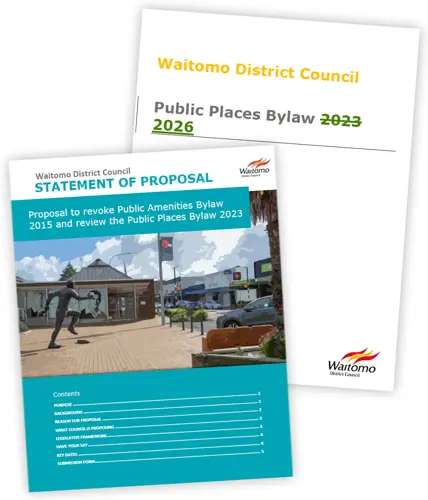
Waitomo District Council is proposing to revoke the Public Amenities Bylaw 2015 and review the Public Places Bylaw 2023. We’re seeking community feedback before any final decisions are made.
What we're proposing
Waitomo District Council (WDC) is proposing to revoke the current Public Amenities Bylaw 2015 and replace this with a separate Cemeteries Bylaw (see separate proposal) and move relevant sections to the Public Places Bylaw 2023.
The proposal would update how we define public places, facilities and amenities so that the Public Places Bylaw can regulate activities and conduct in all Council-controlled public places, facilities and amenities.
)
FAQs
Background
Waitomo District Council currently has both a Public Amenities Bylaw and a Public Places Bylaw. The Public Amenities Bylaw was last reviewed in 2014 and must be updated or replaced by February 2027, while the current Public Places Bylaw was adopted in 2023.
As part of its review, Council found there was significant overlap between the two bylaws, and that some matters are already covered through other legislation, Council bylaws, the District Plan or reserve management plans. Council is therefore proposing to revoke the Public Amenities Bylaw and bring the relevant provisions into an updated Public Places Bylaw 2026. Cemetery-specific requirements are proposed to sit separately within a new Cemeteries Bylaw.
The proposed approach is intended to provide clearer and more consistent rules for Council-controlled public places, facilities and amenities, while reducing duplication and making the requirements easier to understand and administer.
Why is Council reviewing the Public Places Bylaw?
Council has reviewed the Public Amenities Bylaw 2015 and found there’s significant overlap with the existing Public Places Bylaw, as well as some matters that are already covered by other legislation, bylaws, the District Plan or reserve management plans.
Rather than continuing with two bylaws covering similar areas, Council is proposing to bring the relevant public amenity provisions into an updated Public Places Bylaw.
What Council is proposing and what are the main changes?
Council is proposing to revoke the Public Amenities Bylaw 2015 and bring the relevant provisions into an updated Public Places Bylaw 2026. This would create one clearer and more consistent set of rules for Council-controlled public places, facilities and amenities, while cemetery-specific requirements would sit in a separate proposed Cemeteries Bylaw.
The main changes include:
clearer definitions of Public Place and Public Amenity
extending general rules around conduct, obstruction, signage and damage to public amenities
updated provisions for public swimming pools
specific provisions for beaches
recognising libraries and other Council-controlled facilities as public places for general conduct requirements
clarifying how the bylaw works alongside other legislation, bylaws, the District Plan and reserve management plans
modernising wording and definitions to improve clarity and consistency.
What places would the updated bylaw apply to?
The proposed bylaw would apply to Council-controlled public places, facilities and amenities. This includes places such as roads, footpaths, parks, reserves, beaches, public swimming pools, libraries, cemeteries and other Council facilities.
What is a ‘public place’ and a ‘public amenity’?
Under the proposed bylaw, a public place is an area open to or used by the public that’s owned, managed, maintained or controlled by Council. This can include roads, streets, car parks, footpaths, cemeteries, reserves, parks, beaches, walkways and Council-controlled facilities.
A public amenity is a structure, feature or piece of equipment in a public place that’s owned, managed, maintained or controlled by Council – for example seating, picnic tables, signs, monuments or play equipment.
Are there new rules for public swimming pools?
The proposed bylaw brings specific swimming pool provisions into the Public Places Bylaw. These cover matters such as pool closures, overcrowding, photography or recording in changing rooms, supervision of children under eight, glass containers and following instructions from pool staff or authorised officers.
What changes are proposed for beaches?
The proposed bylaw includes specific provisions for beaches. These cover activities such as horses and other animals in swimming areas, vehicle and horse access over dunes, disposing of fish or fish waste, and interfering with lifesaving or warning equipment.
Are the rules around alcohol changing?
The draft continues to include alcohol controls for specified public places. The locations where these controls apply are listed in Schedule 2 of the proposed bylaw, including a number of public areas in Te Kūiti.
Does the proposed bylaw change the rules for dogs?
No. Dogs are specifically excluded from the definition of “animal” in this bylaw. Rules relating to dogs are dealt with separately through Council’s Dog Control Bylaw and Policy.
What happens to cemetery rules?
Cemeteries will still be considered public places, so the general provisions of the Public Places Bylaw will continue to apply.
However, cemetery-specific activities and requirements are proposed to be covered by a separate Cemeteries Bylaw 2026, which is being consulted on separately.
Why doesn't the bylaw include every rule that applies in a public place?
Some activities are already regulated through national legislation, other Council bylaws, the District Plan or reserve management plans. The proposed Public Places Bylaw is intended to work alongside those requirements rather than duplicate or override them.
How can I have my say?
You can read the Draft Public Places Bylaw Review 2026 and make a submission before 5pm, Saturday 31 October 2026.
You can tell us whether you support the proposed bylaw and whether there’s anything you think should be changed or considered.
What happens after consultation closes?
Council will consider all submissions received.
Anyone who asks to speak to their submission will have the opportunity to do so at a hearing. Council will then consider the feedback before making a final decision on the proposed bylaw.
Key Dates
1 October 2026 | Submissions Open |
31 October 2026 | Submissions Close |
17 November 2026 | Hearings (should people wish to speak to their submissions) |
24 November 2026 | Deliberations & Adoption – Council discusses feedback from the community and changes are agreed to if appropriate. |
24 November 2026 | Council adopts the final Bylaw. |